
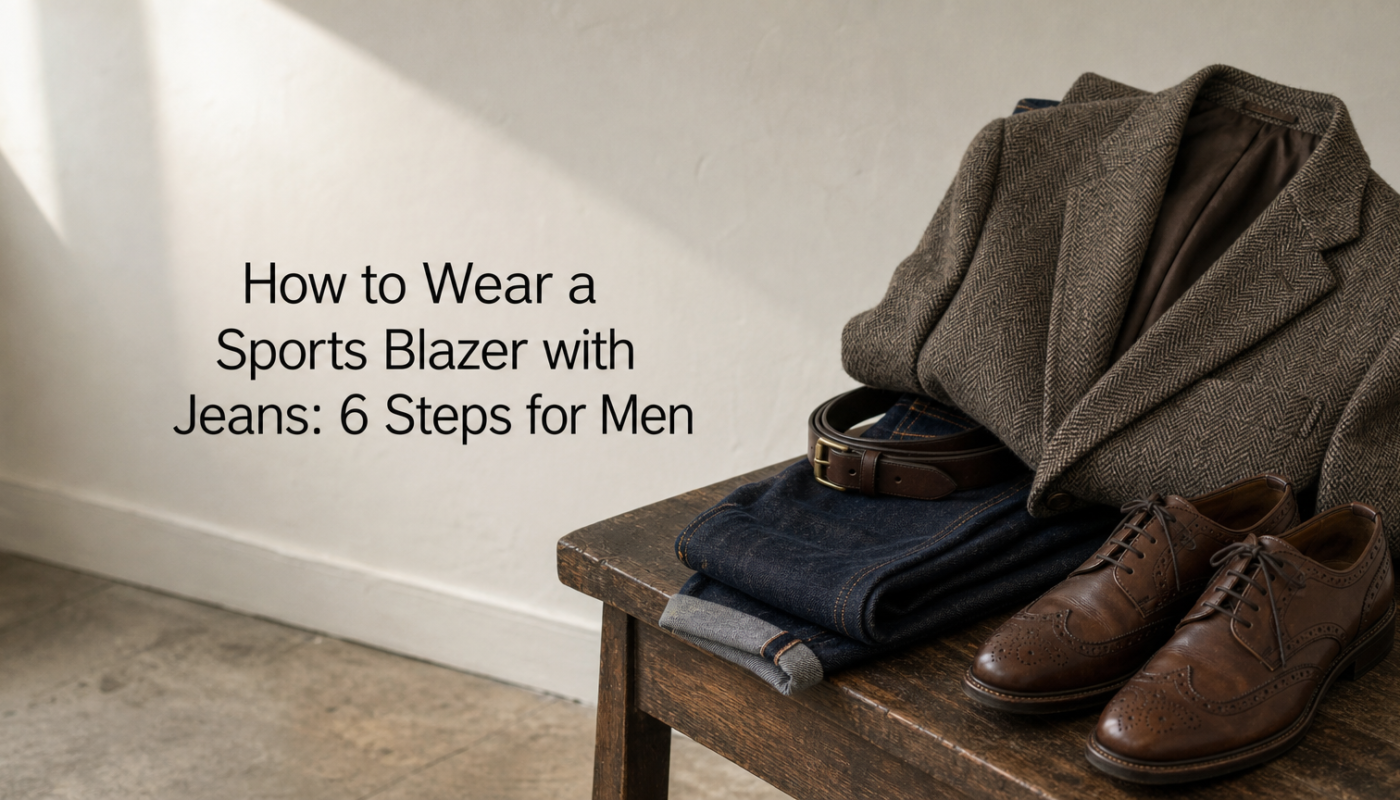
The simplest way to wear a sports blazer with jeans is to keep the two pieces close in formality. Choose an unstructured jacket in a textured fabric, pair it with dark, clean, straight or slim jeans in a clearly different shade, and make sure the shoulders and sleeves fit. Add an open-collar shirt and brown leather shoes or boots. That is the whole formula, and it works for almost every men’s blazer with jeans outfit.
The trouble is that most men get one piece wrong. They throw a suit jacket over faded jeans, pick a boxy jacket that hangs off the shoulders, or finish with running shoes. The result reads as half a suit, formal on top and sloppy below. Product grids and forum threads rarely help, because they show finished outfits without explaining why they work, and they disagree on whether a blazer, a sport coat or a suit jacket is the right choice.
This guide from Boulevard Insight, where we cover smart casual dress codes and everyday styling, walks you through six steps. You will choose the jacket, choose the jeans, check the fit, add the shirt, pick the shoes, and match the outfit to the occasion. Each step gives you a rule you can test against your own closet.
Sport coat vs blazer: what works with jeans
A sport coat is the safest jacket to wear with jeans, an unstructured blazer comes second, and a suit jacket is almost never right. The ranking follows formality. Jeans are casual, so the jacket has to lean casual too, or the two halves of the outfit stop matching.
How a sport coat, blazer and suit jacket differ
Shoppers often search for a "sports blazer," which usually means the casual end of the range: a sport coat or a soft, unstructured blazer. The table shows how the three jackets compare when denim is involved.
| Sport coat | Blazer | Suit jacket | |
|---|---|---|---|
| Fabric | Textured: tweed, herringbone, corduroy, flannel, linen, cotton | Smoother, often navy wool such as hopsack or serge | Fine, smooth worsted wool, often with a slight sheen |
| Color and pattern | Checks, plaids, earth tones, muted shades | Mostly solid: navy, gray, black, sometimes green or burgundy | Solid or subtle stripe, matched to its trousers |
| Structure | Soft shoulders, patch pockets common | More structured, often metal or contrasting buttons | Most structured and sleek |
| With jeans | Best choice | Works if soft and worn with dark denim | Avoid |
The sport coat began as a garment for hunting, riding and other outdoor pursuits, which explains the patch pockets, soft shoulders and rough fabrics. Those details echo the ruggedness of denim. The blazer comes from boating and naval dress. It is more polished, so it needs dark jeans and a soft construction to avoid looking like a suit jacket on casual trousers.
A suit jacket fails for two reasons. Its smooth worsted cloth, often with a faint sheen, clashes with the coarse twill of denim, and its sharp tailoring pushes the formality of the top half far past the jeans. Keep the suit jacket with its trousers and buy a separate jacket for your denim.
The more casual the jacket, the better it sits with jeans.
Is a blazer with jeans still in style?
Yes. Men have worn this pairing for decades, and a men’s blazer with jeans remains a staple of smart casual dressing. What changes from year to year is detail, such as lapel width and how tapered the jeans are. The principle of matching formality and keeping the fit sharp does not change.
One limit applies. Jacket and jeans is a casual outfit, not a semi-formal one. It suits dinners, casual offices, travel and relaxed social events. Step 6 covers the occasions where you should wear trousers instead.
Step 1. Pick the right jacket
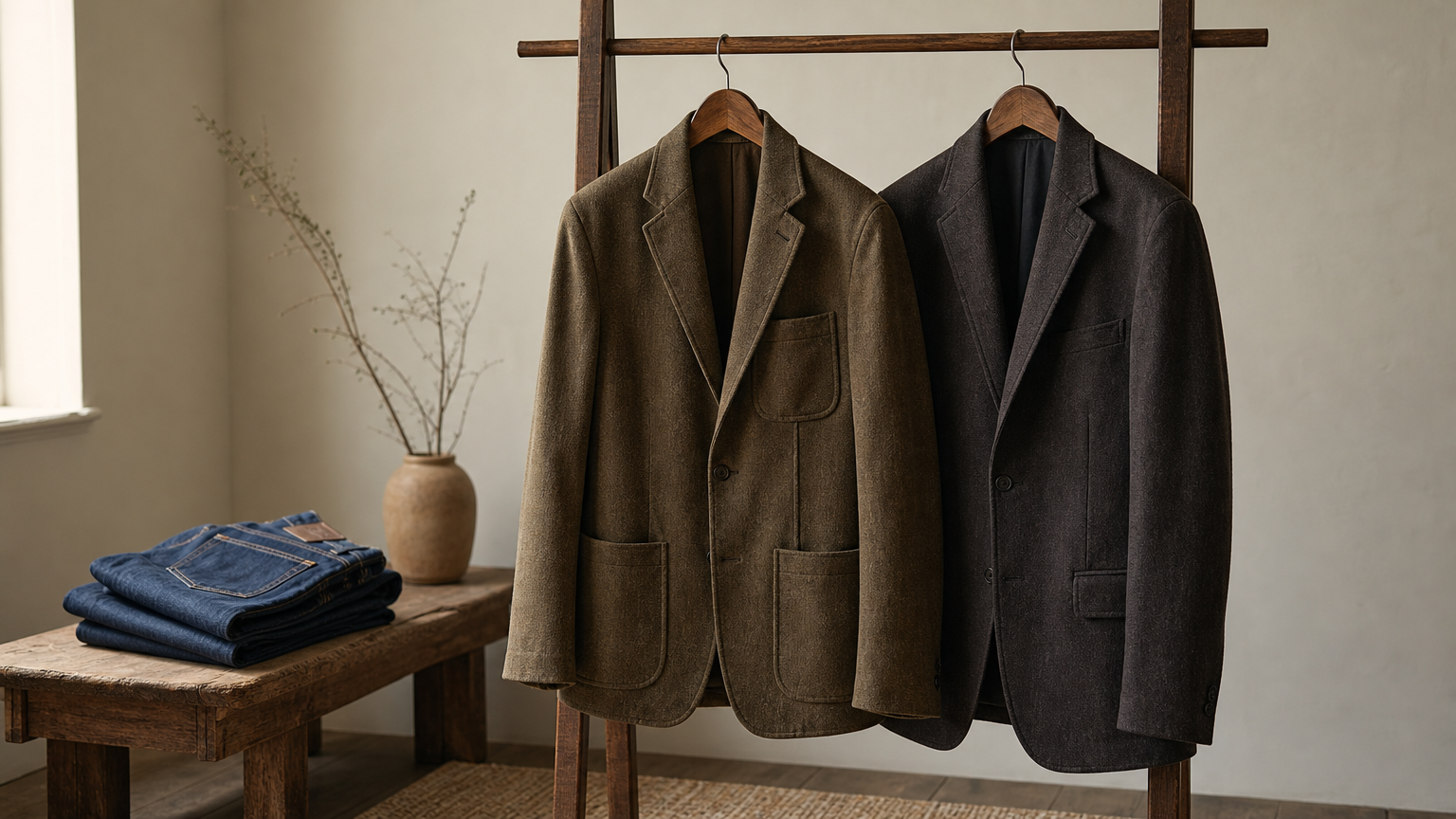
Start with an unstructured sport coat or blazer in a textured fabric, in a color that contrasts with your jeans. If you buy only one jacket, make it a navy blazer in cotton or hopsack with soft shoulders. If you buy a second, make it a textured sport coat in gray or brown. Those two answer the question of the best sport jacket to wear with jeans for nearly every man.
Fabric and color
Fabric decides both the season and the formality of the outfit. Use the table to match cloth to the weather, and notice that the dressier options are the ones with the smoothest finish.
| Fabric | Best season | Look | Pairs well with |
|---|---|---|---|
| Tweed or herringbone | Fall, winter | Rustic, classic | Dark indigo or black jeans |
| Corduroy | Fall, winter | Relaxed, collegiate | Dark indigo jeans, earth tones |
| Flannel | Fall, winter | Soft, matte | Dark denim, oxford or chambray shirts |
| Wool hopsack | Spring through fall | Clean, versatile | Medium or dark wash, white denim |
| Cotton twill | Spring, summer, early fall | Casual, easy | White or dark denim |
| Linen or linen blend | Summer | Breezy, wrinkles easily | Dark or white denim, polos |
Color is where many outfits quietly fail. Aim for clear contrast between jacket and jeans. A lighter or mid-tone jacket looks best on dark denim, and a navy jacket needs a medium wash or white denim, because navy over navy looks like a mismatched suit. Gray and brown textured coats work best over dark indigo or black jeans, where the cloth’s texture stands out.
Contrast between jacket and jeans is what separates an outfit from a mismatched suit.
Details that make a jacket jeans-friendly
Beyond fabric, a few construction details tell you at a glance whether a jacket will sit comfortably with denim. Check this list before you buy.
- Soft, lightly padded shoulders instead of sharp, built-up ones
- Patch pockets, sewn onto the outside of the jacket
- Two buttons rather than three
- Notch lapels of moderate width rather than wide peak lapels
- A matte, visibly woven cloth rather than a shiny one
Sport coats are usually cut a little roomier than suit jackets so you can layer underneath. That is fine, but the jacket should still not look baggy. Step 3 shows you how to check the fit in the fitting room, so keep the shirt you plan to wear in mind when you try jackets on.
Step 2. Choose the jeans
Wear dark, clean jeans in a slim or straight cut, with no rips, fading or whiskering, and hem them to a slight break or none. Treat them as casual trousers. The jeans should look as sharp and well fitted as the jacket above them.
Wash and condition
Deep indigo, black and charcoal denim give the jacket a clean base and read dressier than lighter washes. Raw and selvedge denim are good choices because they hold their color and shape longer than cheap, stretchy pairs. Lighter washes are an exception, not a rule. They can work in warm weather under a navy cotton blazer, and white denim looks good with an unstructured cotton jacket in summer.
Avoid acid wash, heavy fading, rips, frayed hems and holes. They clash with the tailoring of a jacket and make the outfit look accidental. A quick test: if you would not wear the jeans to a nice dinner on their own, they do not belong under a blazer.
If you would not wear the jeans to a nice dinner on their own, do not put a blazer over them.
Cut and fit, including bootcut
The cut matters as much as the wash. This table shows how each common cut behaves under a sport coat or blazer.
| Cut | With a blazer? | Notes |
|---|---|---|
| Slim straight | Best choice | Tailored through the thigh, clean line to the ankle |
| Straight | Works well | Especially good with a textured sport coat |
| Tapered | Works well | Suits loafers and clean sneakers |
| Bootcut | Only with boots | Needs a modest opening and a long enough hem |
| Skinny | Usually avoid | Looks strained against a structured jacket |
| Baggy or wide | Avoid | Looks sloppy beside tailoring |
Bootcut jeans with a blazer cause the most debate among men. They can work, but only if the leg opening is modest, the hem is long enough to cover the top of your boots, and you actually wear boots. With loafers or sneakers, a bootcut hem flaps and breaks the clean line. If you are unsure, choose straight or slim straight, which look right with every shoe in Step 5.
Length and hem
Your jeans should have a slight break or no break, meaning the hem just touches the top of your shoes. Fabric bunching around the ankle makes the outfit look careless, however good the jacket is. Have the hem adjusted by a tailor if needed, and pin it while you wear the shoes you plan to style the outfit with. Slim and straight cuts look best a touch shorter, while a bootcut hem should sit longer, over the boot.
Step 3. Check how the jacket fits
A jacket fits when the shoulder seam ends at the edge of your shoulder, the sleeves end at your wrist bone, and the front closes flat without pulling. Fit is the foundation of the whole outfit. Sleeves and hems are easy to alter, but shoulders are complex and costly to change, so judge them first.
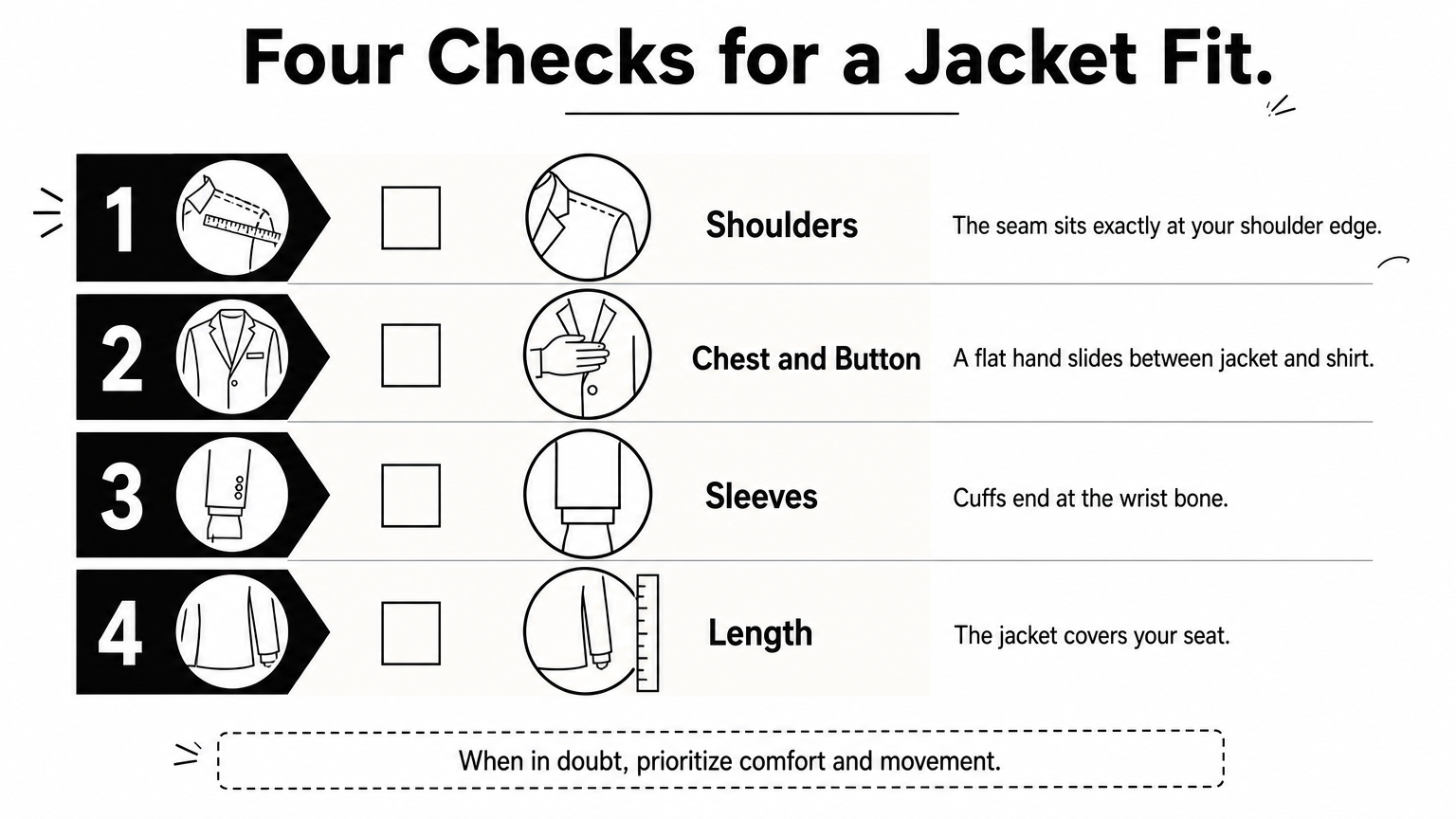
Run the four-point fit check
Try the jacket on over the shirt you plan to wear, and go through these checks in front of a mirror.
- Shoulders: the seam sits exactly where your shoulder ends. If it hangs over, the jacket is too big. If it sits high and you see wrinkles or pulling across the upper back, it is too small.
- Chest and button: fasten the top button only. A flat hand should slide between jacket and shirt. A whole fist means too loose. A tight "X" crease around the button means too tight.
- Sleeves: they end at the wrist bone, showing roughly a quarter to a half inch of shirt cuff.
- Length: the jacket covers your seat. A shorter man can wear it a little shorter, ending just below the waist, to look longer in the leg.
With jeans, the casual cut gives you some room on length, but the shoulders and sleeves are not negotiable. A soft, unstructured jacket has less padding to hide a poor shoulder fit, so any flaw there shows more quickly than on a structured jacket.
Shoulders are the one part of a jacket you cannot fix cheaply, so check them first.
Buttoning and tailoring
On a two-button jacket, fasten only the top button when you stand, never the bottom one, and unbutton it when you sit. On a three-button jacket, fasten the middle button, and the top one too if you like the look. Leaving the jacket open is also fine over jeans, as long as the fit still looks clean from the front.
A good tailor can shorten sleeves, take in the waist, and adjust the length of the jacket. Those alterations turn a decent off-the-rack jacket into one that looks made for you. Spend the money on sleeves and waist rather than trying to fix a jacket that is wrong in the shoulders, and hem your jeans in the same visit.
Step 4. Add the shirt and layers
Wear an open-collar button-down for a dressier look, or a polo, fine-gauge knit or heavyweight plain tee for a casual one. Keep the shirt in step with the jacket. A smoother, dressier jacket needs a crisper shirt, and a rough tweed or cotton jacket can take something more relaxed.
Choose the shirt
These are the shirts that work under a sport coat or blazer with jeans, from dressiest to most casual:
- Oxford button-down in white or light blue, the safest choice with a navy blazer
- Checked or striped button-down, which adds pattern when the jacket is plain
- Chambray or denim shirt, best under a textured or very casual jacket
- Polo or knit polo, good in warm weather under a cotton or linen jacket
- Fine-gauge crew or v-neck knit, a smart choice in fall and winter
- Plain tee, the most casual option
Opinions differ on the tee. My position: a well-fitted plain tee in a heavier cotton works under an unstructured jacket for a weekend or travel outfit. It does not work under a sharper navy blazer or in any setting where you want to look dressed. Leave the collar open on button-downs, because a buttoned-up collar without a tie looks stiff.
Keep the shirt a step more casual than you think the jacket needs.
Layers, tie and finishing touches
In cold weather, a v-neck sweater or casual vest between shirt and jacket adds warmth and gives the outfit depth. Check that the jacket still closes comfortably over the extra layer, since the fit test in Step 3 changes slightly with a sweater underneath.
A tie is optional with jeans. If you wear one, choose a thicker, textured tie such as knit or wool, not shiny silk, so it matches the rustic quality of the jacket and denim. A pocket square works the same way. Pick cotton, linen or wool and use a simple, low-profile fold. Finally, match your belt to your shoes, in brown with brown shoes and black with black.
Step 5. Finish with the right shoes
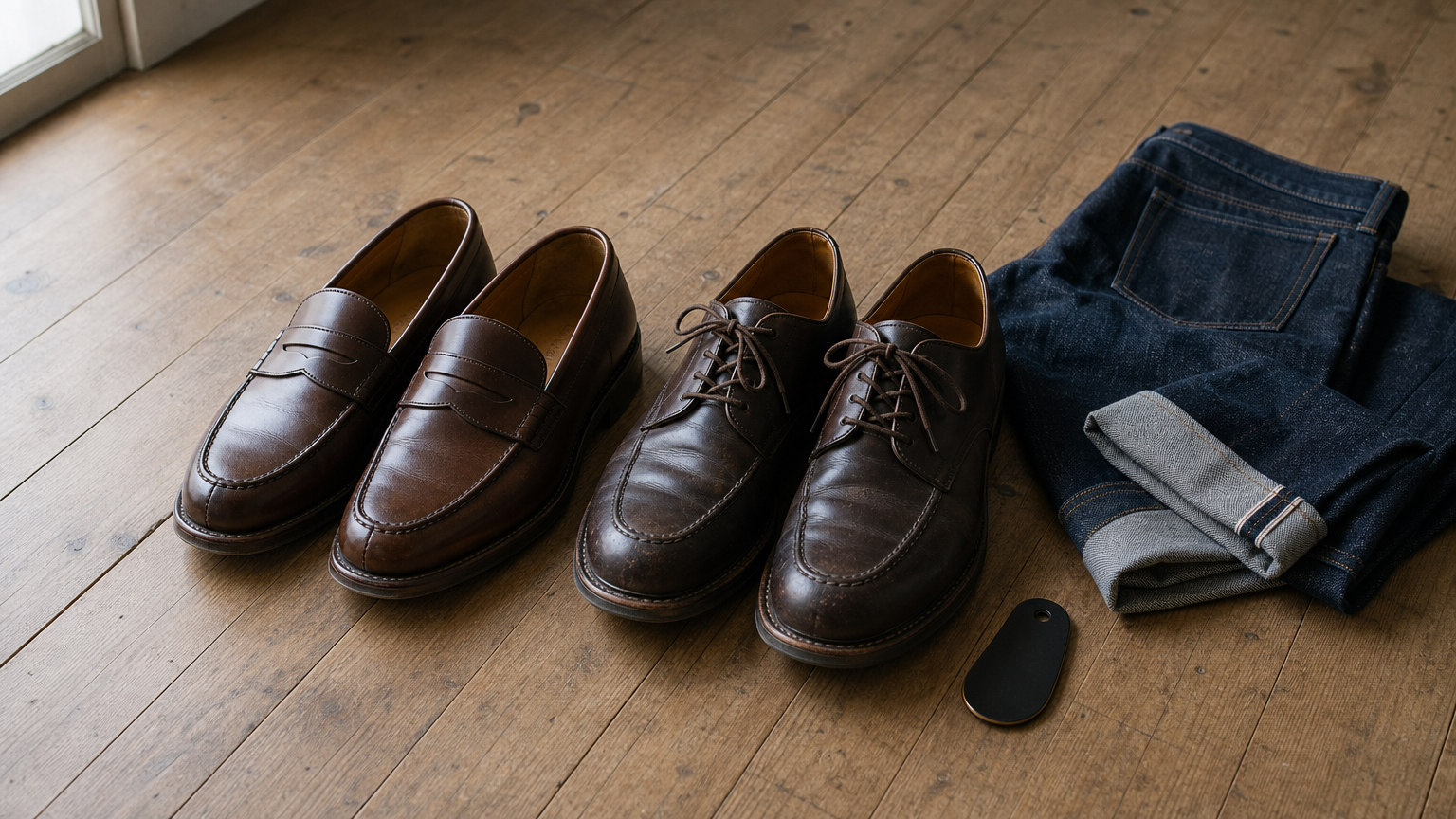
Brown leather loafers, derbies, brogues, chukka boots and Chelsea boots are the reliable choices under a sport coat or blazer with jeans. Skip running shoes and gym trainers. They are the fastest way to turn a smart outfit into a messy one, and your shoes should sit at the same formality as your jacket.
Shoes from dressy to casual
The table ranks the options so you can pick the one that matches your jacket and shirt.
| Shoe | Formality | Pairs well with |
|---|---|---|
| Brown brogues or derbies | Dressiest | Navy blazer, oxford shirt, dark straight jeans |
| Loafers, including suede | Smart casual | Almost any jacket and jean combination |
| Double monk straps | Smart casual | Navy blazer, slim straight jeans |
| Chelsea boots | Smart casual | Slim jeans, gray or navy jackets |
| Chukka boots | Casual | Tweed, corduroy or flannel sport coats |
| Work or dress boots | Rugged | Textured sport coat, chambray shirt |
| Cowboy boots | Casual, regional | Straight or bootcut jeans, worn over the boot |
| Clean minimal leather sneakers | Most casual | Cotton blazer, tee or polo |
Brown, tan and oxblood leather all go well with denim and with most jacket colors. Black shoes work best with black or charcoal jeans and a gray jacket, and look harsh with indigo. Cowboy boots with a sport coat and jeans are a classic look that works particularly well in regions where boot culture is strong, but they only look right when the jeans fall over the boot, as covered in Step 2.
Pick shoes that sit at the same formality as the jacket, not the jeans.
Sneakers and socks
Sneakers are the one footwear choice where men disagree most. They can work, but only low-profile, clean sneakers in white, off-white or gray leather or suede, under a casual cotton or unstructured jacket. Chunky running shoes, bright colors and worn-out pairs do not. Keep the hem slim or straight so the shoe shows.
Socks are a small detail with a visible effect. Choose a color close to your jeans or shoes so no skin shows when you sit, or go with low-cut socks only if you are wearing loafers with a cropped hem. Avoid white athletic socks with leather shoes.
Step 6. Match the outfit to the occasion
A sport coat or blazer with jeans suits dinners, casual offices, travel and relaxed social events. It does not suit formal events. Match the jacket’s texture and your shoes to how dressy the setting is, and wear trousers when the dress code says formal or cocktail.
Four outfit formulas
Use these blue jeans and blazer combinations as a starting point. They show how each step fits together for common situations.
| Occasion | Jacket | Jeans | Shirt | Shoes |
|---|---|---|---|---|
| Dinner date | Navy hopsack blazer | Dark indigo slim straight | White oxford, open collar | Brown loafers |
| Casual or creative office | Gray herringbone sport coat | Black or dark indigo straight | Light blue oxford or fine-knit sweater | Brown derbies or chukkas |
| Weekend or travel day | Tan or navy cotton blazer | Dark tapered | Plain heavyweight tee or polo | Clean leather sneakers |
| Cold-weather casual | Brown tweed or corduroy | Dark indigo | Chambray or flannel shirt, knit tie optional | Chelsea or work boots |
The first row is the best place to begin if you own only one jacket. A navy blazer, dark indigo jeans, a white oxford and brown loafers is a complete, reliable outfit that rarely misses.
When jeans are the wrong call
Jeans are usually the wrong choice for a wedding, because most weddings expect trousers. The exception is a clearly casual or outdoor wedding, and even then wear your darkest, cleanest pair with the dressiest version of the outfit: a navy blazer, an oxford shirt and leather shoes. Check the invitation and the dress code before you decide, and when in doubt, wear trousers.
Apply the same rule to job interviews, funerals and formal dinners. Jacket and jeans fits a casual or creative workplace, but a business or conservative interview calls for a suit or tailored trousers.
When the invitation says formal or cocktail, leave the jeans at home.
A final check before you leave the house
Here is a worked example. You have chosen a navy hopsack blazer, dark indigo straight jeans, a white oxford and brown loafers. Run through these questions:
- Contrast: the navy jacket and indigo jeans differ enough? If they look alike, switch to a medium wash or gray jacket.
- Formality: is everything smart casual, with no suit jacket and no gym shoes?
- Fit: do the shoulders sit at your shoulder edge and the sleeves end at the wrist bone?
- Hem: do the jeans graze the top of your shoes with a slight break?
- Match: do the belt and shoes match?
If every answer is yes, you are ready to go.
Wear it with confidence
A sports blazer with jeans works when you keep formality close and the fit sharp. Pick a soft, textured jacket, add dark and clean straight or slim jeans in a contrasting shade, check the shoulders and sleeves, and finish with an open-collar shirt and leather shoes or boots. Skip the suit jacket, the ripped denim and the running shoes, and the outfit will look deliberate in almost any casual or smart casual setting.
Once you have one reliable formula, you can vary it by season, fabric and occasion without starting from scratch each time. For more outfit guides and smart casual dress code advice for men, browse the style and fashion guides at Boulevard Insight.
