Most people upgrading their phone right now are asking the same question. You find a great 5G phone, the price looks right, and then someone at the store or a YouTube comment drops the word “6G.” Suddenly you’re second-guessing everything.
Here is what nobody tells you upfront: the choice is not between 5G and 6G. Not yet. Right now, the real choice is between acting on solid information or getting paralyzed by hype. This article gives you the facts so you can decide with confidence.
Where 5G Actually Stands in 2026
After years of slow rollouts and oversized promises, 5G has finally found its footing. Most major cities across North America, Europe, and parts of Asia now have dependable 5G coverage. The experience on a good connection is genuinely different from 4G. Downloads are faster, video calls are more stable, and mobile gaming latency has dropped in a way you can actually feel.
That said, 5G is not one single experience. It breaks down into two very different types.
Sub-6GHz 5G is what most people actually use daily. It covers wider areas and delivers speeds between 100 and 400 Mbps. It is not the fastest version of 5G, but it is consistent and practical.
mmWave 5G is the ultra-fast version with speeds reaching 1 to 3 Gbps. The catch is that it only works within a short range and is mostly available inside stadiums, airports, and dense city centers. You are unlikely to use it on your morning commute.
Most 5G phones sold today support sub-6GHz. Only flagship models in select markets include full mmWave support, and even then, the situations where it kicks in are limited. For the average user in 2026, 5G is a real and meaningful upgrade over 4G.
What 6G Actually Is Right Now
Here is the straightforward truth: 6G does not exist as a commercial network yet. No carrier is selling 6G plans. No phone has genuine 6G hardware. What does exist is serious research and early standardization work, which is important but very different from something you can buy today.
The International Telecommunication Union is currently building the framework for 6G under the name IMT-2030. The target specifications being discussed are genuinely impressive.
Peak speeds are projected at up to 1 Terabit per second, which is roughly a thousand times faster than peak 5G. Latency is expected to drop below one millisecond, compared to the already strong 10ms that 5G delivers today. Networks will also be designed from the ground up with AI built into their core architecture, meaning the network itself will adapt and optimize in real time.
The earliest realistic date for commercial 6G is 2030. Mainstream availability in most markets is more likely a 2032 to 2035 timeline. Countries leading the charge include South Korea, Japan, China, Finland, and the United States, but all of them are still in the research and testing phase.
How 5G vs 6G Ready Phones Actually Differ in Hardware
This is the part that matters most for anyone shopping for a phone right now.
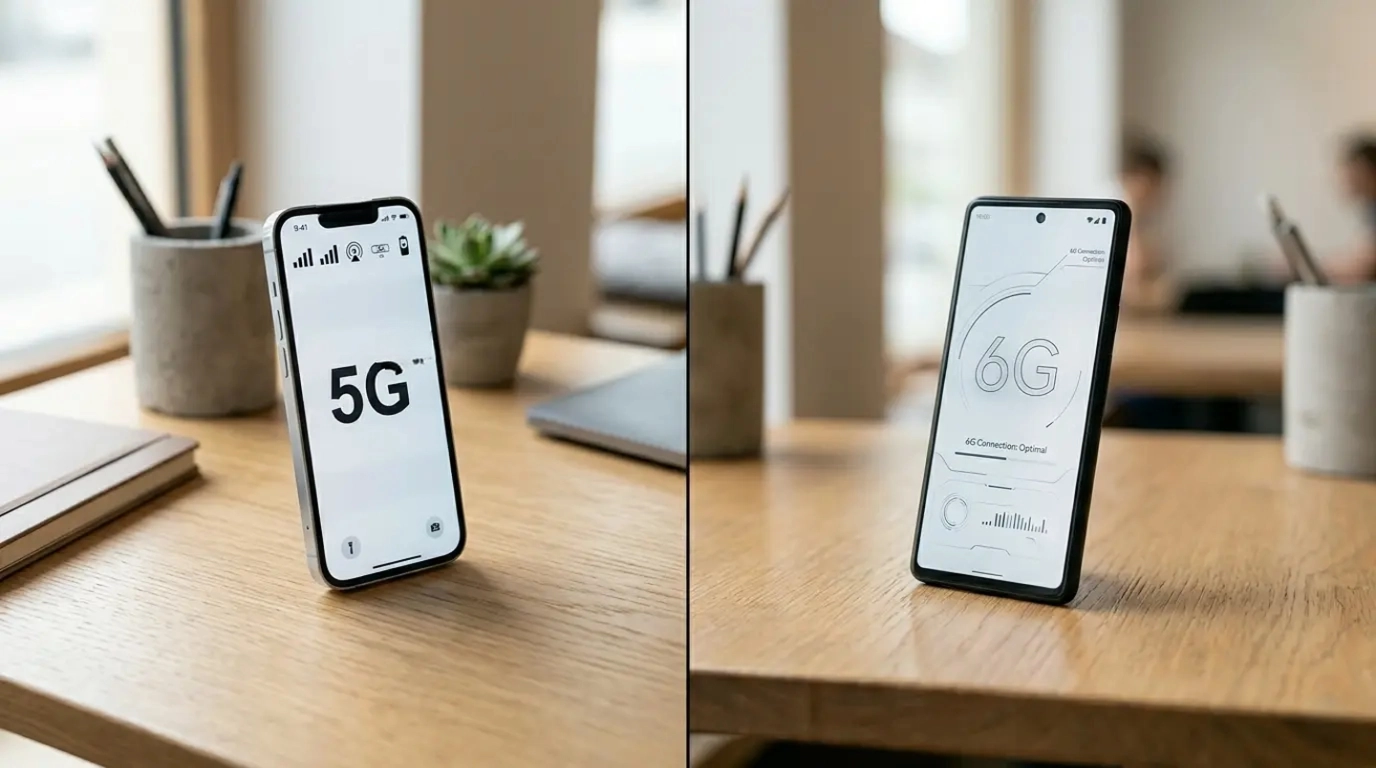
There is no such thing as a true 6G-ready consumer phone today. Some manufacturers may start using that phrase in marketing materials, but what they mean at best is that their device supports 5G Advanced, which is an upgraded version of 5G under Release 18 and Release 19 standards. That is a meaningful improvement, but it is still 5G.
When real 6G devices eventually arrive, they will require fundamentally different hardware. The terahertz spectrum that 6G will use requires entirely new antenna designs and modem chips. Your current 5G phone cannot be updated into a 6G phone through software. The physical components are simply not compatible.
Current flagships running on chips like the Qualcomm Snapdragon X Elite or MediaTek Dimensity 9400 already include features that lay useful groundwork for next-generation connectivity, such as advanced beamforming, carrier aggregation, and AI-enhanced signal processing. These are genuinely useful technologies. They just do not make a phone 6G-ready in any technical sense.
Should You Buy a 5G Phone Right Now
The answer is yes, and the reasoning is simple.
6G commercial networks will not reach most cities before 2030 at the earliest. By that point, a quality phone purchased today will already be four to five years old and due for a natural upgrade cycle anyway. Waiting for 6G before buying a 5G phone is like refusing a solid meal today because a better restaurant is opening in four years.
If you are currently on a 4G device and eligible for an upgrade, a good 5G phone in 2026 is the right move. You will benefit from genuine speed improvements, better streaming, improved gaming performance, and a device that will stay relevant throughout its natural lifespan.
For more perspective on how faster connectivity and data technology are changing industries beyond just phones, it is worth seeing how tools like retail business intelligence are already reshaping the way businesses operate using real-time data.
Why 6G Is Bigger Than Just Phone Speed
The most important thing about 6G is that it is not primarily about making your phone faster. It is about enabling things that are currently impossible.
Holographic communication becomes viable at 6G speeds. Real-time 3D projection over a network requires a level of data throughput that 5G cannot sustain consistently. With 6G, that barrier disappears.
Remote surgery and tactile internet become practical realities. When a surgeon operates a robotic system from another city, the network cannot afford a single millisecond of lag. Sub-1ms latency makes that level of precision achievable.
Autonomous vehicle coordination improves dramatically. Connected cars sharing road data with each other and with infrastructure need response times measured in fractions of a millisecond. 6G is built for exactly that kind of environment.
6G is less about your personal device and more about the digital infrastructure layer that smart cities, automated logistics, immersive AR, and critical remote services will run on. Phones will participate in that ecosystem, but they are not the main story.
FAQ’s
Are there any 6G phones available to buy right now?
No. As of 2026, there are no commercial 6G networks and no consumer phones with genuine 6G hardware. Any device marketed using the term “6G-ready” is either referring to 5G Advanced features or using marketing language that is not technically accurate.
Will my 5G phone work when 6G launches?
Yes, on 5G and 4G networks. However, it will not connect to 6G. That requires new hardware including antennas and modems designed for terahertz frequencies, which current phones do not have.
What is 5G Advanced and how does it differ from regular 5G?
5G Advanced is an upgrade within the 5G generation, defined by 3GPP Release 18 and 19 standards. It brings better speeds, lower energy usage, and smarter AI integration into the network. Think of it as a significant mid-cycle update before 6G arrives.
When will 6G phones actually be available to buy?
Most credible industry projections point to 2030 to 2032 for first commercial 6G launches. Consumer-grade 6G phones at accessible price points are more realistically a 2033 to 2035 timeframe in most markets.
Is buying a 5G phone in 2026 a waste of money because 6G is coming?
Not at all. 5G networks are actively expanding and improving. A quality 5G phone bought now will serve you well through its natural lifespan, and you will be due for an upgrade long before 6G becomes mainstream anyway.
Which countries are leading 6G development?
South Korea, Japan, China, Finland, and the United States are currently at the forefront, backed by both government funding and major private investment in research and spectrum trials.
The Bottom Line
The gap between 5G and 6G ready phones is real, but it is a gap measured in years, not months. Right now, investing in a quality 5G phone is the smart and practical decision. Networks have matured, device support is solid, and the technology delivers genuine everyday improvements.
6G is genuinely exciting and worth understanding, especially as it will reshape far more than just smartphones. But it belongs in the future planning column, not in the “should I wait before buying a phone” column.