
You stand in front of a closet packed with clothes and still feel like you have nothing to wear. That’s the exact problem a wardrobe capsule solves. Instead of chasing every trend, you build a small, deliberate collection of pieces that all work together, so getting dressed stops being a daily negotiation with yourself.
So what is a wardrobe capsule, exactly? It’s a curated set of clothing, usually 25 to 40 pieces, chosen for versatility rather than volume. A well-planned capsule wardrobe for women mixes neutral basics with a few statement items, all in colors and fabrics that mix and match easily across seasons and occasions.
This guide walks you through building your own women’s capsule wardrobe from scratch. We’ll cover how to audit what you already own, pick a color palette that actually works for your life, choose the essential pieces worth investing in, and adapt the whole system as seasons change. By the end, you’ll have a practical framework, not just a Pinterest-worthy list, for a closet that finally works as hard as you do.
What is a capsule wardrobe, and why build one?
Susie Faux, a London boutique owner, coined the term back in the 1970s to describe a small set of timeless pieces you build a seasonal wardrobe around. American designer Donna Karan popularized the idea in the following decade with her famous “seven easy pieces” collection. So when people ask what is a wardrobe capsule, the honest answer is: it’s not a new trend, it’s a decades-old strategy for dressing that outlasts fashion cycles. The concept never really changed; only the shopping habits around it did.
At its core, a capsule is a short list of clothes chosen to combine in dozens of ways rather than sit unworn most of the year. What is in a capsule wardrobe usually breaks down like this: a handful of bottoms (trousers, jeans, a skirt), a few tops that layer well, one or two dresses, a blazer or cardigan, outerwear suited to your climate, and three to five pairs of shoes. Everything shares a color story, so a top from one outfit slides into three others without a second thought.
Why the math works in your favor
Here’s the part most articles skip: a capsule isn’t about owning less for the sake of minimalism, it’s about owning fewer things that each do more work. Compare the two approaches side by side:
| Typical Closet | Capsule Wardrobe | |
|---|---|---|
| Pieces owned | 100+ | 25-40 |
| Pieces regularly worn | ~20% | 80%+ |
| Outfit combinations | Limited by mismatched colors | Dozens from shared palette |
| Morning decision time | 10-15 minutes | Under 5 minutes |
| Closet maintenance | Constant sorting, donating | Seasonal swap only |
A women’s capsule wardrobe built on this ratio turns your closet into a tool instead of a storage problem. You stop staring at a full rack feeling like you own nothing to wear, because everything left in there actually earns its hanger space.
A capsule wardrobe works because every piece has to pull its weight, not because you own less stuff.
Who actually benefits from this approach
Women juggling packed schedules get the most out of a capsule wardrobe woman system, since it removes a decision point from an already long list of daily choices. New parents, frequent travelers, and anyone rebuilding a wardrobe after a move or a size change also find it useful, because it forces you to define what you actually need before you start buying again. A ladies capsule wardrobe isn’t a strict uniform either; you can still rotate accessories, swap a scarf, or add a bold shoe to keep outfits from feeling repetitive.
The difference between a capsule and just “minimalist” fashion
People sometimes confuse a female capsule wardrobe with extreme minimalism, imagining ten identical black outfits. That’s a misread. A well-built capsule can include color, pattern, and personality; the constraint is coordination, not blandness. Your neutrals (black, camel, navy, white, gray) form the backbone, while two or three accent colors and one or two patterns give the collection life. The goal is a closet where nearly any top pairs with nearly any bottom, not a closet stripped of character.
Once you understand what a capsule wardrobe actually is, the next question is practical: how do you get from a closet full of “maybe someday” pieces to one where everything belongs? That starts with an honest look at what you already own, which is exactly where step one begins.
Step 1. Audit your current closet and lifestyle
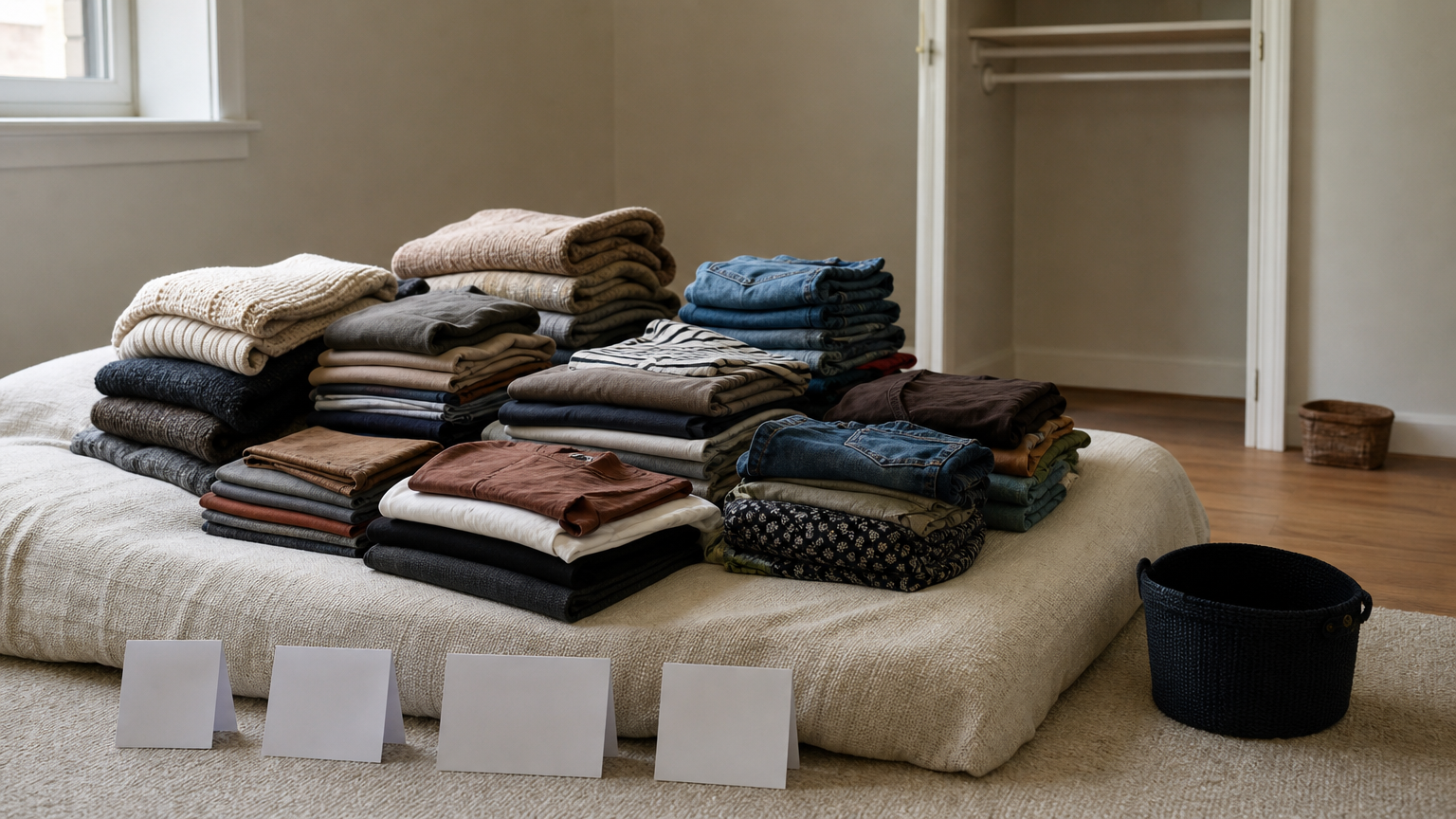
Before you buy a single new item, empty the closet completely. Pull every hanger, drawer, and shoebox out onto your bed and look at what you’ve actually accumulated. This step feels tedious, but it’s the only way to build a capsule wardrobe for women that reflects your real life instead of an aspirational one you saw on a mood board. Most closets are full of clothes bought for a version of you that doesn’t exist anymore, and you can’t fix that problem without seeing it laid out in front of you.
Sort into four honest piles
Grab sticky notes or masking tape and label four zones on the floor: Keep, Alter, Donate, and Undecided. Go piece by piece and ask one question: have you worn this in the last twelve months? If the answer is no and it’s not seasonal outerwear or formalwear, it goes in Donate. Be ruthless here; sentimental attachment is the number one reason capsules fail before they start.
You can’t build a working capsule wardrobe on top of a closet full of guilt purchases.
Track what you actually reach for
While you sort, keep a running list of the pieces you pulled out most often, the ones with slightly worn soles or a little fading from repeat washing. These are your proven performers, and they belong at the center of your new wardrobe capsule. A simple tracking method works well:
- High rotation: worn weekly, in good condition, keep automatically
- Occasional: worn a few times a season, evaluate for versatility
- Untouched: unworn in a year, default to donate unless it’s a rare formal piece
- Doesn’t fit: separate pile regardless of how much you love it
Sort your remaining pieces this way, and patterns emerge fast about what you actually wear versus what you thought you’d wear.
Map your week, not your fantasy
Once the piles are sorted, write down how your week actually breaks down: days at a desk, days on your feet, gym sessions, school runs, date nights, whatever applies. A women’s capsule wardrobe only works if it matches this real schedule, not an idealized one where you attend five cocktail parties a month. Count the ratio of casual to formal days, note your climate’s actual weather patterns rather than the fashion-calendar seasons, and keep that list handy. You’ll use it in the next step to decide which colors, fabrics, and proportions actually deserve a spot in your closet.
Step 2. Define your style, colors, and constraints
Now that your closet is empty and sorted, pull out the Keep pile again and look for a pattern. Which colors show up over and over? Which necklines, fabrics, and silhouettes did you reach for without thinking? A woman capsule wardrobe built around your existing preferences fits your life immediately, instead of forcing you to adjust to someone else’s idea of a “classic” closet.
Pick a palette you’ll actually wear
Start with two or three neutrals as your foundation, then add one or two accent colors that show up in your Keep pile already. This is the backbone of a working capsule wardrobe women rely on for years, not just one season.
- Base neutral: your most-worn color (black, navy, camel, or gray)
- Secondary neutral: a lighter or darker complement (white, cream, or charcoal)
- Accent 1: a color you already own multiples of
- Accent 2: optional, for seasonal variety
A capsule wardrobe collapses fast if the palette doesn’t match colors you naturally gravitate toward.
Skip any color you “should” like because a stylist recommended it. If you never reach for burgundy in real life, it won’t suddenly become your favorite because it’s in a capsule.
Name your dominant style, then set hard limits
Give your style a name in plain language: classic-minimal, soft-boho, sporty-tailored, whatever fits. This single sentence becomes your filter for every future purchase decision in a capsule wardrobe for women built to last. Constraints matter just as much as style. Write down your non-negotiables before you shop:
| Constraint | Example |
|---|---|
| Fabric | No dry-clean-only pieces |
| Fit | Must work for sitting at a desk all day |
| Care | Machine washable only |
| Climate | No wool blends in humid summers |
| Budget ceiling | Nothing over $80 per piece |
Writing these down protects you later, when a beautiful blazer tempts you off-course at checkout.
Test your palette against your calendar
Hold your chosen colors up against the week you mapped in Step 1. Do they work for both desk days and weekend errands? Every piece in a women’s wardrobe capsule should photograph well in your actual lighting and match your actual routine, not a magazine spread. If a color only works for one occasion type, demote it to an accent rather than a core neutral. This small check now saves you from a closet full of pieces that look great individually but refuse to combine when it matters most.
Step 3. Decide your capsule size and budget
With your palette and constraints written down, you need a number. How many pieces actually belong in your wardrobe capsule? There’s no universal magic figure, despite what half the internet claims. The right count depends on your climate, how often you do laundry, and how many distinct roles your wardrobe has to fill in a given week.
Match your piece count to your lifestyle
Start with a range, not a fixed target. A capsule wardrobe women with desk jobs and predictable weekly rhythms build usually lands smaller than one built for someone splitting time between fieldwork, travel, and evening events.
| Lifestyle Type | Suggested Piece Count | Notes |
|---|---|---|
| Remote or hybrid worker, casual dress code | 25-30 | Fewer formal pieces needed |
| Office job, business casual daily | 35-40 | Needs more structured pieces |
| Frequent traveler or multi-role schedule | 40-45 | Extra layering options required |
| Parent with unpredictable days | 30-35 | Prioritize washable, forgiving fabrics |
Pick the row closest to your actual week from Step 1, then adjust up or down by five pieces based on your climate’s seasonal swing. Cold climates with distinct winters often need a few extra pieces just for outerwear and layering, so it helps to see how stylish cold-weather outfits are built before you set your number.
Set a budget you can actually track
Budgeting for a capsule wardrobe for women works best when you separate one-time investment pieces from replaceable basics. Decide upfront how much of your total budget goes toward each category:
- Investment pieces (40% of budget): coat, blazer, boots, one dress
- Core basics (35% of budget): trousers, jeans, tops, cardigans
- Accents and accessories (25% of budget): scarves, jewelry, one statement item
This split keeps you from blowing the whole budget on trendy accents while your foundational pieces stay thin.
A capsule wardrobe only saves you money if you plan the budget before you start shopping, not after.
Calculate cost-per-wear before you buy anything
Before committing to a piece, divide its price by how many times you realistically expect to wear it per year. A $120 blazer worn 60 times a year costs $2 per wear; a $40 top worn twice costs $20 per wear. That second number should stop you cold. Applying this math to every candidate purchase in your women’s capsule wardrobe filters out impulse buys fast, because pieces that only work for one occasion or one season rarely justify their price once you run the numbers honestly.
Step 4. Build your core essentials checklist
Now you translate your piece count, palette, and budget into an actual shopping list. This is the moment a wardrobe capsule stops being an abstract idea and becomes a checklist you can hand to yourself at any store. Skip this step and you’ll end up buying whatever looks good that day, which is exactly the impulse-shopping cycle a capsule is supposed to fix.
Start with the base layer everyone needs
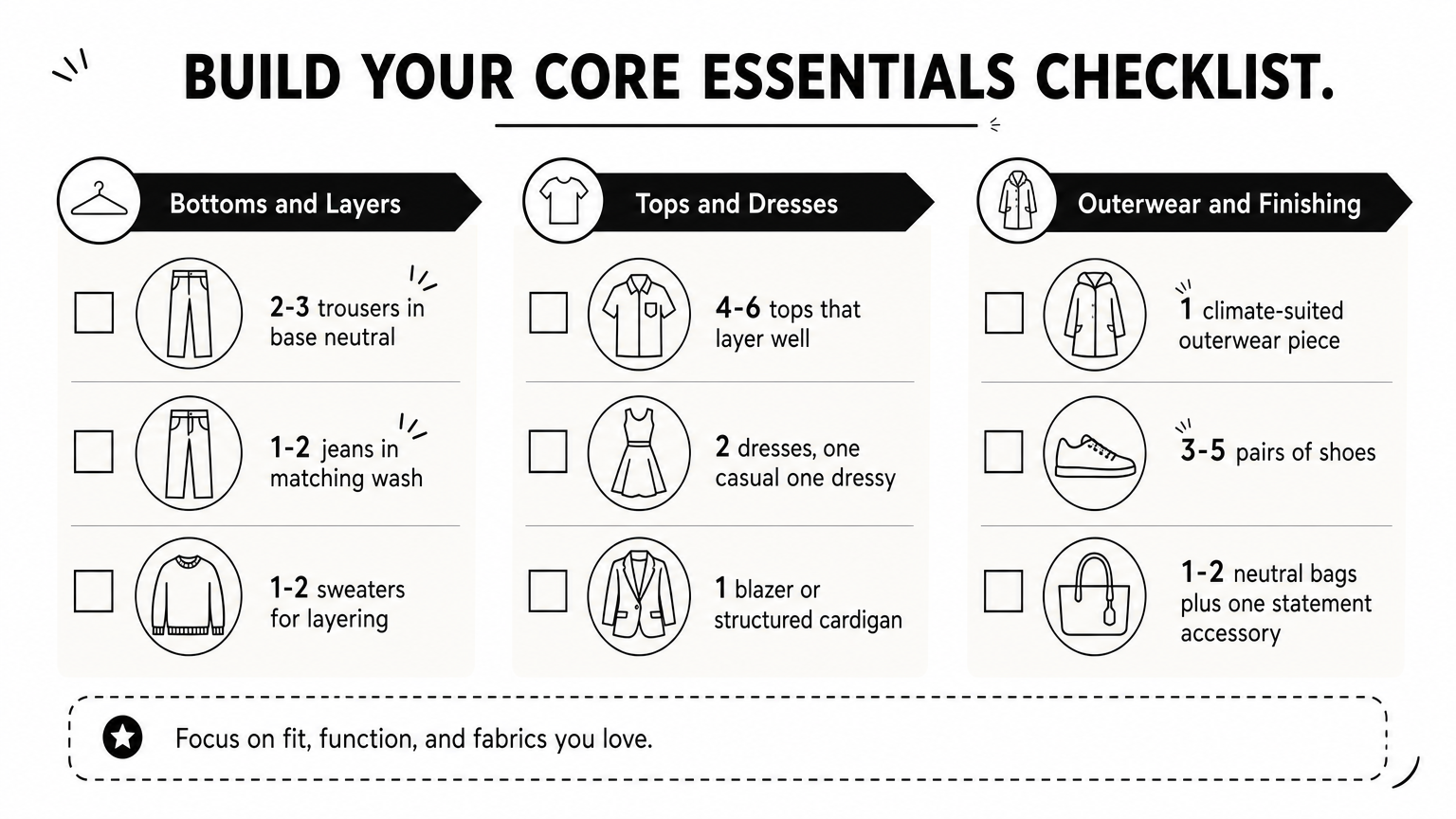
Every capsule wardrobe for women needs a foundation of pieces that work in almost any combination, regardless of your specific style name from Step 2. Use this as your starting checklist, then adjust the quantities up or down based on your lifestyle row from Step 3:
- 2-3 pairs of trousers or tailored pants in your base neutral
- 1-2 pairs of jeans in a wash that matches your palette
- 4-6 tops that layer under a blazer or cardigan
- 2 dresses, one casual and one that can dress up
- 1 blazer or structured cardigan
- 1-2 sweaters or cardigans for layering
- 1 outerwear piece suited to your actual climate
If a piece can’t pair with at least three other items on this list, it doesn’t belong in your core essentials.
Match quantities to your real week
Overbuying tops while underbuying bottoms is the most common mistake in a women’s capsule wardrobe, so cross-check every category against the week you mapped in Step 1. If four of your five weekdays involve sitting at a desk under a smart casual dress code, you need more tailored trousers than casual joggers. If weekends mean errands and gym runs, add a second pair of leggings or comfortable jeans instead of a third blazer you’ll rarely wear.
Don’t forget the finishing pieces
Quietly, shoes and accessories decide whether your core essentials actually function day to day, and they get skipped more often than any other category. Plan for three to five pairs of shoes covering flat, heeled, and athletic needs, plus one or two bags in your neutral colors. A capsule wardrobe women rely on for years usually includes one statement accessory, a bold scarf or bag, that adds personality without disrupting the color logic underneath. Round out the list with basics like a slip or camisole for layering under sheer tops, since these invisible pieces quietly extend the wearability of everything else on your checklist.
Write your finished list down somewhere you’ll actually reference it, whether that’s a notes app or a printed sheet taped inside your closet door. You’ll need it in the next step, when it’s time to go shopping and fill whatever gaps this audit revealed.
Step 5. Shop strategically to fill the gaps
Compare your finished checklist from Step 4 against what survived your closet audit in Step 1. Whatever’s missing becomes your actual shopping list, not a vague browsing session through every sale email in your inbox. This is where a capsule wardrobe for women either stays disciplined or quietly turns back into an overstuffed closet, depending on whether you shop with a list or shop with a mood.
Shop your gaps in order, not all at once
Fill investment pieces first, since they take longer to find at the right price and quality, and if you want a shortcut, these Amazon capsule wardrobe pieces for the season cover several gaps at once. A good coat or blazer might take three or four store visits before you find the right cut, so start there rather than leaving it for the last weekend before winter. Work through your gaps in this order:
- Outerwear and structured pieces (coat, blazer): longest to source, highest cost-per-wear payoff
- Bottoms (trousers, jeans): fit matters more than fabric here, so try multiple brands
- Shoes: buy for comfort first, color second
- Tops and layering pieces: fastest to find, easiest to swap later
- Accents and accessories: fill these last, once the core is solid
Shop investment pieces first; everything else is easier to replace if you get it wrong.
Try before you commit, every time
Never buy a core piece online without trying a similar cut in a store first, even if you end up purchasing the online version for a better price. A women’s capsule wardrobe depends on fit more than fabric or color, and a trouser that pulls at the hip or a blazer that gapes at the button undoes all the palette planning from Step 2. Bring your constraints list from Step 2 into the fitting room with you and check every piece against it before it leaves the store.
Resist the almost-perfect purchase
A piece that’s close to your palette but not quite right will sit unworn just like the guilt purchases you donated in Step 1. If a top only pairs with one bottom in your closet, or a color falls slightly outside your chosen neutrals, walk away regardless of how good the fabric feels. This discipline is what separates a capsule wardrobe woman who ends up with a functioning closet from one who rebuilds the same cluttered mess with fewer, pricier items. Give yourself a 48-hour rule for anything over your per-piece budget ceiling from Step 3; if you still want it two days later, and it fills a genuine gap, buy it. If you’ve forgotten about it, you’ve saved yourself a wasted hanger.
Step 6. Group pieces into mix-and-match modules
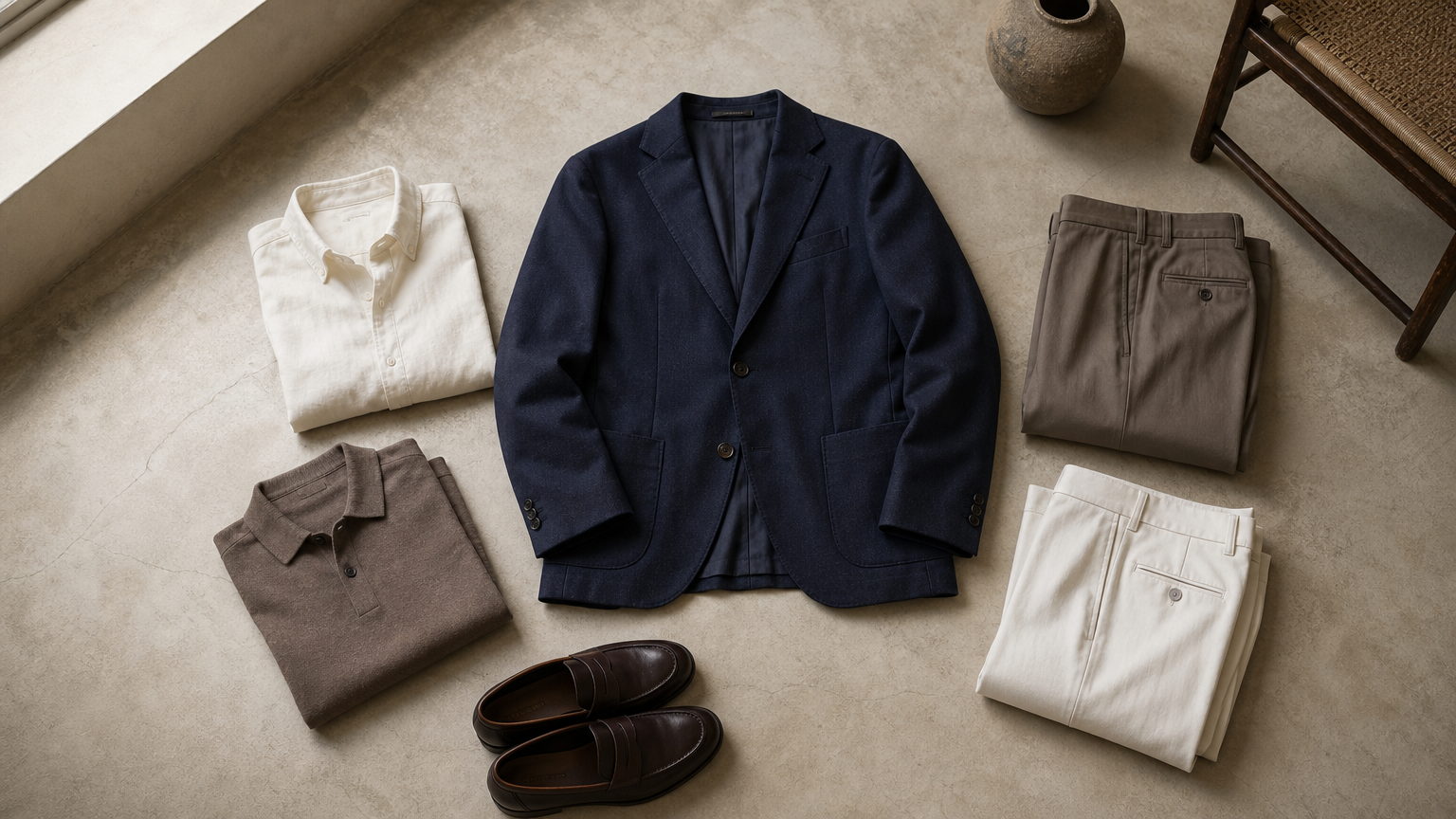
Once your closet holds only the pieces from your checklist, the real work starts: turning individual items into outfits you’d actually wear. Grouping your wardrobe capsule into modules, small clusters of three to five pieces that all combine with each other, makes this concrete instead of theoretical. Think of each module as a mini capsule inside your capsule, built around one core piece like a blazer or a pair of trousers, with everything else in the group chosen specifically to pair with it.
Build modules around your hardest-working pieces
Start with your most versatile item, usually a blazer, a pair of dark trousers, or a neutral dress, and list every other piece in your closet that pairs with it cleanly; there are more ways to style a simple black dress than most closets ever use. Do this for four or five anchor pieces, and you’ll notice most of your closet overlaps between modules rather than sitting in isolated clusters. A capsule wardrobe for women with well-built modules looks something like this:
| Module Anchor | Pairs With | Occasions Covered |
|---|---|---|
| Navy blazer | 2 trousers, 1 dress, 3 tops | Office, dinner, travel |
| Dark denim | 4 tops, 1 cardigan, 2 shoes | Weekend, casual desk day |
| Wrap dress | Blazer, cardigan, 2 shoe types | Date night, work, brunch |
| White button-down | 3 bottoms, blazer, cardigan | Nearly everything |
If a piece only fits into one module, it’s not earning its place in the capsule yet.
Count your combinations, not just your pieces
Grouping this way exposes math that a simple item count hides. Twelve tops and eight bottoms in a shared palette produce close to a hundred outfit combinations before you even add layering pieces or accessories. Multiply that by three shoe options and two outerwear choices, and a modest women’s capsule wardrobe stretches across weeks without repeating an identical look. This is the payoff for the discipline you applied back in Step 2 when you limited your palette; every piece staying in-family is what makes this multiplication possible.
Fill the gaps you find between modules
Overlapping modules also reveal where your closet is thinner than it looks. If your blazer module only produces two outfits while your denim module produces six, that imbalance tells you where to focus your next purchase or your next round of styling experiments. Rather than shopping randomly, you now have a specific, evidence-based reason to add one more top or a second cardigan to strengthen the weakest module. Note these gaps somewhere visible, because you’ll want them fresh in mind for the next step, where you actually put these combinations to the test in real outfits, on real days, not just on paper.
Step 7. Test, wear, and refine your outfits
Now you actually live in the closet you built. Pull outfits straight from your modules for two full weeks and wear them exactly as planned, resisting the urge to fall back into old habits mid-week. A capsule wardrobe for women only proves itself through real days, not through a spreadsheet, so this stretch of wearing is where theory either holds up or falls apart.
Run a two-week wear test
Wear a different module each day and take a quick photo before you leave the house, and if you run dry mid-week, these casual smart outfit ideas for ladies give you twelve ready-made combinations to borrow from. This takes thirty seconds and gives you an honest record of what actually left the closet, rather than what you assumed you’d reach for. Keep it simple:
- Day 1-5: rotate through your five strongest modules
- Day 6-10: repeat with different shoe or accessory pairings
- Day 11-14: mix modules together, pairing an anchor from one with pieces from another
By the end of two weeks, you’ll have worn most of your wardrobe capsule at least twice, which is enough data to spot real patterns instead of guessing.
Track what doesn’t work
Somewhere visible, jot down every outfit that felt off, whether it pinched, wrinkled badly, or just looked wrong in the mirror. Note the specific reason, not just “didn’t like it,” since vague notes won’t help you fix anything later. A women’s capsule wardrobe improves fastest when you’re specific:
Piece: gray cardigan
Issue: too long for tucked-in tops, bunches at waist
Fix: only pair with dresses or untucked tops
An outfit that looks good on paper but wrinkles or pinches in real life doesn’t belong in your rotation, no matter how well it matched your palette.
This kind of log turns vague dissatisfaction into a concrete edit list, which is far more useful than simply feeling like something’s not working.
Adjust before you shop again
After the two weeks, review your notes and make three piles: pieces to keep as-is, pieces to alter (a hem, a tailor’s nip at the waist), and pieces to replace entirely. A female capsule wardrobe shouldn’t stay static after this test; small tailoring fixes often solve problems you’d otherwise blame on the piece itself. Take the alteration pile to a tailor before you write anything off as a bad purchase, since a five-dollar hem can rescue a pair of trousers you almost donated. Only once you’ve made these adjustments should you return to Step 5’s shopping list, now armed with real evidence about which gaps actually matter and which ones existed only on paper.
Step 8. Maintain and rotate your capsule by season
A finished capsule isn’t a finished project. Every three to four months, you’ll swap pieces as weather shifts, and that swap is where most women’s capsule wardrobe systems either stay sharp or slowly drift back into clutter. Treat this rotation as routine maintenance, not a full rebuild, since the framework you built in Steps 1 through 7 doesn’t need to change, only the specific pieces filling it.
Set a seasonal swap calendar
Mark four dates on your calendar, roughly aligned with your actual climate rather than the fashion calendar’s arbitrary seasons. On each date, pull out the off-season storage bin and do a fifteen-minute check against your core checklist from Step 4:
- Spring swap: store heavy coats and knits, bring in lighter layers and transitional jackets
- Summer swap: add breathable fabrics, rotate in open shoes, store wool entirely
- Fall swap: reintroduce layering pieces, check blazers and cardigans still fit and fit your palette
- Winter swap: bring back outerwear, add thermal layering basics under existing tops
This calendar keeps your wardrobe capsule from becoming a single static set of clothes that ignores six months of the year.
Retire pieces before they retire your outfits
During each swap, check every piece against the notes you gathered in Step 7’s wear test. Anything that pilled, faded, or lost its shape gets replaced immediately rather than left to quietly drag down a module’s usefulness. A capsule wardrobe for women stays functional only when worn-out basics get swapped on schedule, not whenever you happen to notice a hole.
A capsule wardrobe isn’t a one-time project, it’s a system you tune four times a year.
Refresh without overbuying
Replacing a worn cardigan doesn’t mean rebuilding the whole system from scratch. Update one or two pieces per season, using the same cost-per-wear math from Step 3 and the same fitting-room discipline from Step 5. Seasonal trends will tempt you to add pieces outside your palette; let yourself buy exactly one trend item per season if you want it, ideally one of the wearable autumn styles worth knowing, and keep it in the accent category so it doesn’t disrupt the neutrals underneath. Doing this consistently means your capsule wardrobe woman identity from Step 2 stays intact year after year, even as individual pieces come and go, and it keeps you from ever landing back at the overstuffed, nothing-to-wear closet that started this whole process.
Dressing with less, living with more
A working capsule wardrobe isn’t about owning less for its own sake. It’s about closing the gap between the closet you have and the life you actually live, so every morning starts with a real choice instead of a scavenger hunt. The eight steps here work in order because each one builds on the last: audit, define, plan, buy, group, test, refine, maintain. Skip the audit and you’ll shop blind. Skip the wear test and you’ll never catch the pieces that look right but feel wrong.
Give yourself one full season before judging the results. That’s usually enough time for a women’s capsule wardrobe to prove its worth in mornings saved and outfits repeated on purpose, not by accident. For more seasonal styling guides and outfit inspiration to fill those gaps you found, browse the latest women’s fashion guides on Boulevard Insight.