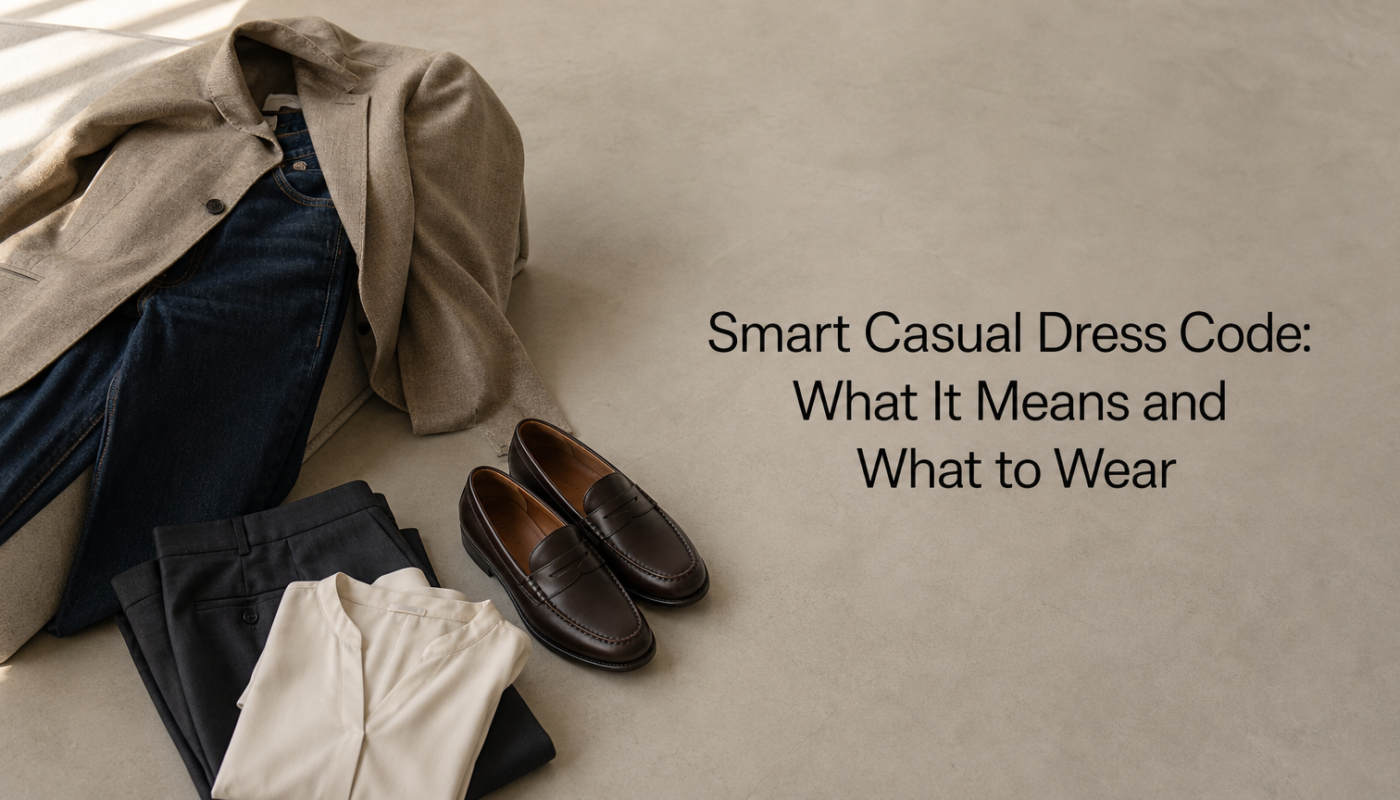
Wondering what smart casual dress code really means? It sits right between formal office wear and weekend casual. You got the invite and it says smart casual, then panic sets in. Jeans feel too casual, a suit feels like overkill, and you have maybe twenty minutes before you need to leave the house. The smart casual dress code sits in that frustrating middle ground where the rules feel unwritten, and guessing wrong means either standing out for the wrong reasons or feeling underdressed all night.
Here’s the short answer: smart casual dress code means polished, put-together pieces that skip the extremes of formal wear and sloppy weekend clothes. Think tailored trousers instead of a suit, a blazer instead of a sport coat, loafers instead of sneakers. It’s structure without stiffness, and once you see a few concrete outfit examples, the concept clicks fast.
This guide breaks down exactly what smart casual means, where it fits between business casual and pure casual, and what to actually pull from your closet for work events, dinners, or weddings. We’ll cover specific clothing items for both men and women, plus common mistakes that push an outfit too far in either direction.
What Smart Casual Dress Code Means and Why It Matters
Companies stopped requiring suits, and that single shift explains most of the confusion around smart casual dress code rules today. Twenty years ago, business attire meant a blazer and tie every single day, full stop. Now offices allow chinos, startups run all-hands meetings in henleys, and the old formal rulebook doesn’t apply anymore. Smart casual filled that gap. It gives people a way to look put together without pretending they’re heading into a courtroom, which is exactly why the term shows up on so many invitations, from Tuesday client dinners to Saturday weddings.
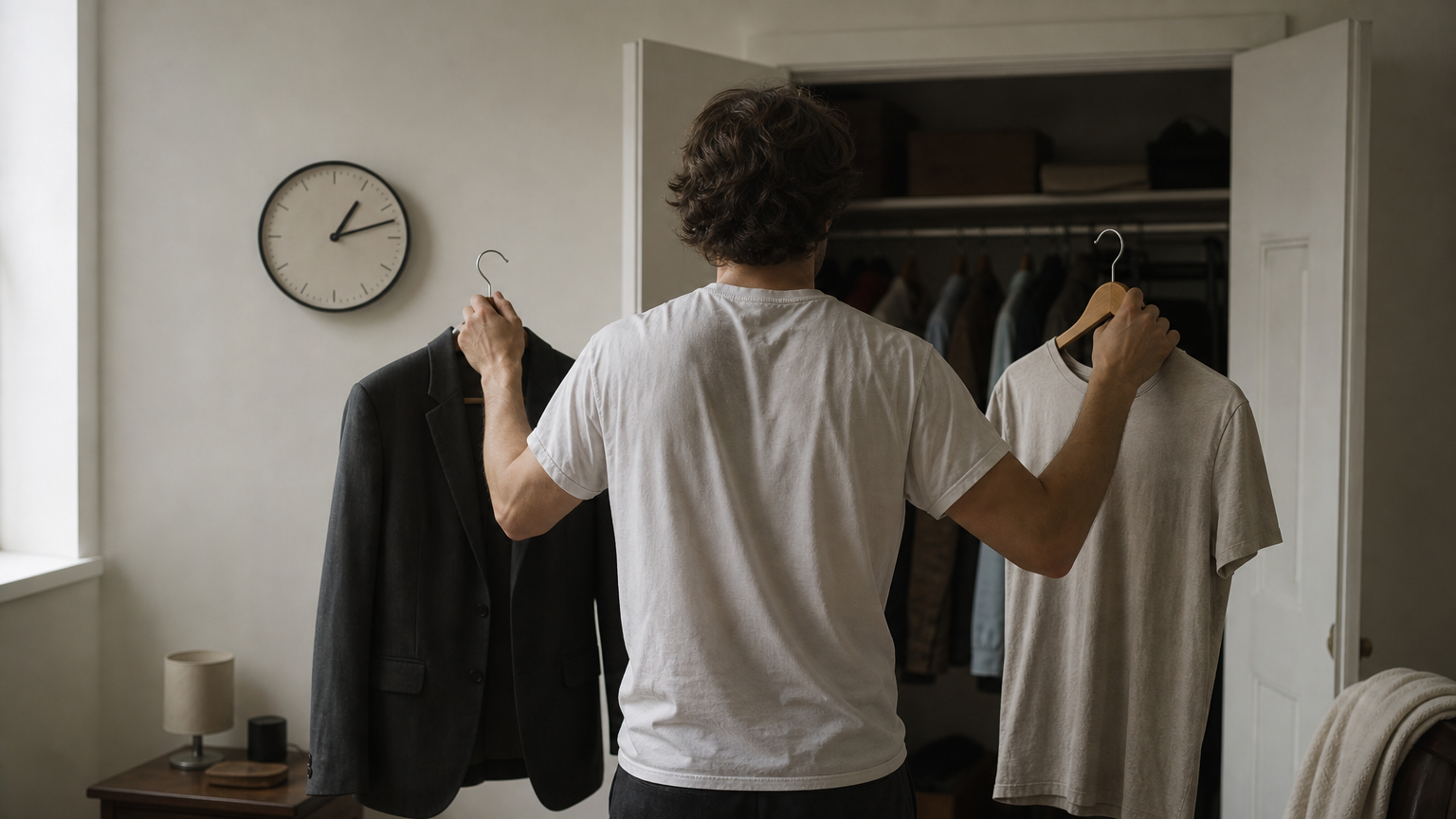
Guessing wrong at a smart casual event costs you more than comfort. Show up underdressed in a t-shirt and sneakers next to colleagues in blazers, and you spend the whole night feeling like you missed a memo. Overdress in a full three-piece suit at a casual rooftop dinner, and you look like you wandered in from a different party. Neither mistake is catastrophic, but both chip away at your confidence in the room, and confidence affects how you network, how you interview, and how you present yourself at your own cousin’s wedding.
Getting smart casual right isn’t about owning more clothes, it’s about owning the right five or six pieces that work everywhere, the kind of capsule wardrobe essentials you reach for again and again.
Understanding what is smart casual dress code guidance actually asks of you matters because the stakes are rarely trivial. Job interviews at companies with a stated smart casual office policy are testing whether you understand unwritten norms, not just whether you can code or sell. Wedding invitations that specify smart casual attire dress code expectations are trying to keep guests comfortable while still photographing well next to the couple in their finest outfits. Restaurant dress codes use the phrase to keep out flip-flops without demanding a jacket. Each context carries its own small penalty for guessing wrong, even if nobody says anything out loud.
Where you’ll run into a smart casual dress code request
You’ll see this phrase far more often than you’d expect once you start paying attention to invitations and workplace handbooks. Common places it shows up include:
- Corporate offices with hybrid or modernized dress policies, especially in tech, marketing, and finance
- Wedding invitations for daytime ceremonies, garden venues, or receptions held outside strict formal venues
- Restaurant and club dress codes posted at the entrance of upscale but not fine-dining establishments
- Networking events and conferences where attendees want to look professional without full business formality
- Family gatherings and milestone dinners, like a parent’s retirement party or a graduation dinner
- Job interviews at companies that list smart casual as their everyday office standard
Every one of these settings shares a common thread: the host wants guests to look effortful and respectful, without forcing anyone into a tie or heels they’ll regret by 9 p.m.
The confidence payoff of getting it right
Once you have a working definition of the smart casual wear dress code down, you stop overthinking every invite. That mental bandwidth matters more than people admit. Walking into a room already confident about your outfit choice means you can focus on the conversation, the interview answers, or the toast you’re about to give, instead of scanning other guests to see if you under- or overshot the mark. Dressing appropriately is a quiet form of respect, both for the host who set the expectation and for yourself.
Research on first impressions backs this up. According to the U.S. Bureau of Labor Statistics, workplace norms around professional presentation continue to shift toward flexibility, but appropriateness within that flexibility still shapes how colleagues perceive competence and reliability (https://www.bls.gov/opub/mlr/). In practice, that means smart casual isn’t a loophole for skipping effort. It’s a different, slightly more relaxed standard that still rewards intention. The next section breaks that standard into specific pieces you can actually put on, for men and women both, so you’re never staring at your closet wondering what counts.

How to build a smart casual outfit for men and women
Building a smart casual outfit comes down to picking one structured piece and one relaxed piece, then letting them balance each other out. A blazer with jeans works. Tailored trousers with a simple sweater works. The formula fails when everything leans casual at once (t-shirt, sneakers, joggers) or when everything leans formal at once (suit, tie, dress shoes), because either extreme misses the whole point of the smart casual attire dress code.
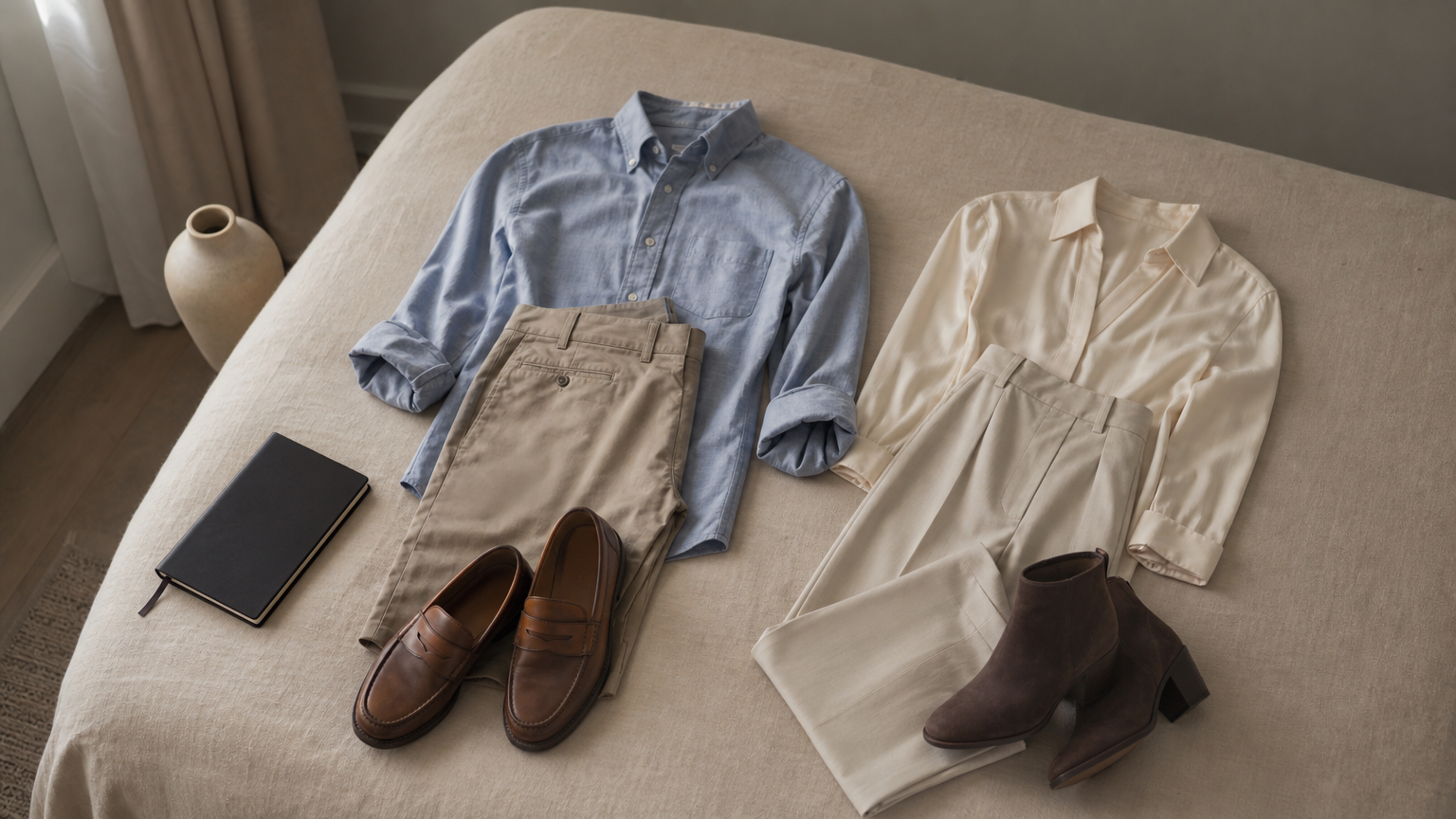
If every piece in your outfit is casual, or every piece is formal, you’ve missed smart casual entirely.
What men should wear
Men have an easier time here because the formula barely changes across settings, and the smart casual male dress code follows a few repeatable rules. Start with tailored chinos or dark denim without rips, then add a button-down shirt or a fine-knit sweater. Layer a blazer or unstructured sport coat on top for dinners, interviews, or weddings, and skip it for lower-stakes office days. Finish with leather loafers, clean derby shoes, or minimalist sneakers, never athletic trainers.
- Chinos or dark, unripped jeans
- Button-down shirt, polo, or lightweight sweater
- Blazer or unstructured sport coat
- Loafers, derbies, or clean minimalist sneakers
- A simple belt and watch to tie the look together
What women should wear
Options expand for women, which sometimes makes the choice feel harder rather than easier, so it helps to see how smart casual translates for women piece by piece. Tailored trousers, a midi skirt, or a structured dress all read as smart casual on their own, and adding a blazer or well-fitted cardigan pushes any of them up a notch for a wedding or client dinner. Pair with heeled ankle boots, block heels, or polished flats, and save strappy sandals or platform sneakers for other occasions; if you want visuals, these casual smart outfit ideas for ladies show the formula in action.
- Tailored trousers, midi skirt, or a structured dress
- Blouse, fitted sweater, or simple top
- Blazer or structured cardigan for added polish
- Ankle boots, block heels, or polished flats
- Minimal jewelry and a structured bag
Quick reference for both
People often ask what separates smart casual from either extreme, so here’s a side-by-side comparison.
| Category | Too casual | Smart casual | Too formal |
|---|---|---|---|
| Bottoms | Ripped jeans, gym shorts | Chinos, tailored trousers, midi skirt | Full dress suit pants |
| Tops | Graphic tee, tank top | Button-down, blouse, fine knit | Formal dress shirt with cufflinks |
| Outerwear | Hoodie | Blazer, structured cardigan | Tuxedo jacket |
| Shoes | Sneakers, flip-flops | Loafers, block heels, ankle boots | Formal dress shoes, stilettos |
Sticking close to that middle column, regardless of the specific event, keeps you safely inside the boundaries of the dress code smart casual invitations are asking for.
Smart casual vs. business casual and other dress codes
Confusion usually starts because smart casual dress code rules get lumped in with business casual, even though the two aren’t the same thing. Business casual leans more formal and more predictable: dress shirts, pressed slacks, closed-toe shoes, minimal denim, while a smart casual code dress leaves more room to interpret. Smart casual gives you more room to play, letting in dark jeans, sneakers if they’re clean, and knitwear instead of collared shirts. If business casual is “office appropriate every day,” smart casual is “office appropriate with personality allowed.”
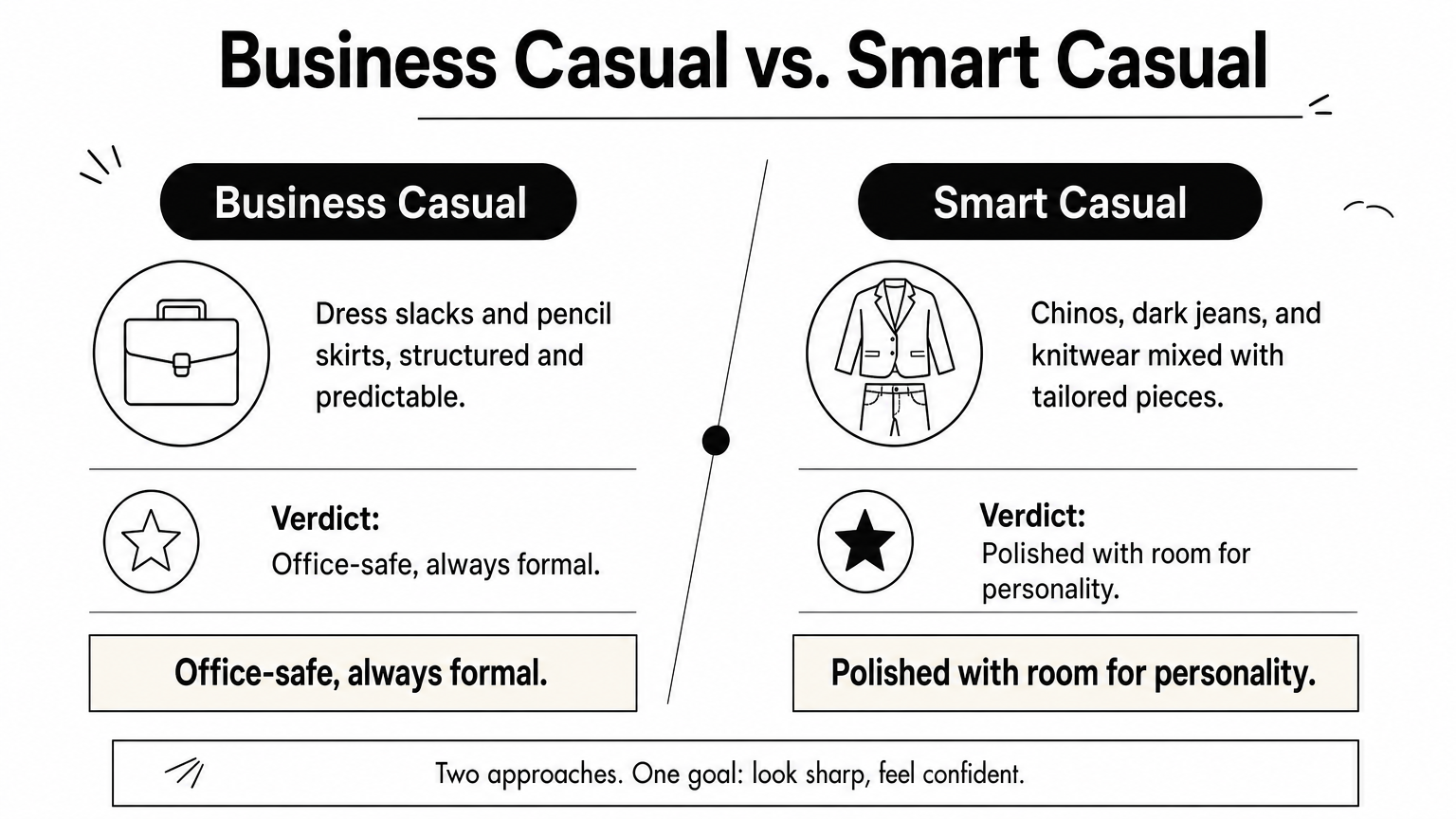
Looking at the full spectrum makes the differences clearer than comparing any two dress codes in isolation. Formal and black tie sit at one end, demanding suits, gowns, and dress shoes with zero exceptions. Casual sits at the other end, welcoming t-shirts, sneakers, and shorts without judgment. Business casual and smart casual attire dress code expectations occupy the middle, but they split that middle differently.
Smart casual isn’t a stricter version of casual, it’s a more relaxed version of business attire.
| Dress code | Bottoms | Tops | Shoes | Typical setting |
|---|---|---|---|---|
| Formal/black tie | Suit pants, gown | Dress shirt, formal gown | Oxfords, heels | Galas, formal weddings |
| Business casual | Dress slacks, pencil skirt | Button-down, blouse | Closed-toe flats, oxfords | Corporate offices, client meetings |
| Smart casual | Chinos, dark jeans, midi skirt | Knit sweater, polo, blouse | Loafers, block heels, clean sneakers | Dinners, weddings, hybrid offices |
| Casual | Any jeans, shorts | T-shirt, tank top | Sneakers, sandals | Weekend errands, casual hangouts |
Misreading this table is exactly how people overshoot or undershoot an invite. Someone told to follow a dress code smart and casual for a Friday dinner who instead wears a full business casual outfit, tie included, ends up looking stiffer than everyone else at the table. Someone who reads “casual” instead of “smart casual” and shows up in gym shorts creates the opposite problem. The word “smart” in front of “casual” is doing real work; drop it mentally and you’ll dress for the wrong occasion.
Workplaces make this trickier because policies vary company to company, and a written dress code casual smart in an employee handbook rarely comes with photo examples. A law firm’s version of smart casual will still skew closer to business casual, while a design agency’s version might allow sneakers and colorful knitwear most offices would consider too relaxed. When you’re unsure which direction a specific workplace leans, look at what senior leadership wears on a normal Tuesday. That’s a more reliable signal than the handbook language itself, and it saves you from either extreme on your first week.
Smart casual dress code: quick answers to common questions
Questions about smart casual dress code rules tend to repeat themselves, so here are direct answers to the ones that come up most often, whether you’re prepping for a wedding, a first date, or a Monday morning at a new office.
What is the smart casual dress code, in one sentence?
Simply put, smart casual attire dress code guidance means pairing one polished piece with one relaxed piece, so a blazer meets dark jeans or a knit sweater meets tailored trousers. Nothing about it demands a tie, a gown, or a full suit, but it also rules out gym shorts and flip-flops. Think of it as business attire that’s been allowed to loosen its collar by exactly one notch, not five.
The safest smart casual outfit is one structured piece plus one relaxed piece, nothing more formal, nothing more casual.
Can men wear jeans under a smart casual dress code?
Yes, but only dark, unripped denim without heavy fading or distressing. Pair those jeans with a blazer or a button-down shirt, and finish with loafers or clean minimalist sneakers rather than athletic trainers. Skip anything with visible logos, rips, or a baggy fit, since those details read as weekend casual instead of smart casual wear appropriate for a dinner or office setting.
Does smart casual work for a wedding invitation?
Weddings that specify smart casual usually want guests who look effortful without upstaging the couple’s formalwear. Women can lean on a midi dress or tailored trousers with a blazer, while men do well in chinos, a collared shirt, and a sport coat; for cold-weather ceremonies, these wedding guest outfits for winter cover the layering problem. Avoid full ball gowns, tuxedos, or anything that competes with the wedding party’s outfits, since overdressing at a smart casual attire dress code wedding is almost as noticeable as underdressing.
Are sneakers ever acceptable?
Clean, minimalist leather or suede sneakers work in most smart and casual dress code settings, especially at hybrid offices or casual dinners. Chunky athletic sneakers, running shoes, or anything with mesh and bright branding do not, no matter how new they look. When in doubt, choose a low-profile sneaker in a neutral color over anything designed for a gym, and borrow from these sneaker outfit ideas to keep the pairing polished.
What should you wear to a smart casual job interview?
Job interviews reward a slightly more conservative reading of what is the smart casual dress code, since you’re meeting people for the first time. Choose tailored trousers or a structured dress, add a blazer, and stick to closed-toe shoes rather than sneakers, even if the office allows them once you’re hired. First impressions favor the safer end of smart casual, and you can always dress it down after you know the office culture firsthand.
Finding your own smart casual balance
Getting the smart casual dress code right isn’t about memorizing rigid rules, it’s about pairing one structured piece with one relaxed piece and trusting that instinct across every invitation you get. Knowing the difference between chinos and gym shorts, or a blazer and a hoodie, means you’ll never freeze up reading an event invite again. That single formula, one polished item plus one easy item, carries you through weddings, interviews, and Friday dinners without a second guess.
Eventually this stops feeling like a puzzle and starts feeling like instinct, the same way you already know not to wear pajamas to a client meeting. Style confidence builds the same way any skill does: repetition, small adjustments, and paying attention to what actually works in the room. If you want more outfit breakdowns, seasonal trend guides, and practical style advice like this, browse our fashion guides and outfit ideas on Boulevard Insight and keep building a wardrobe that never leaves you guessing.